
VW GROUP WARNING LIGHTS // 2026-10-28 // 2 min read
VW Group EPC Warning Light — Electronic Power Control Explained
The amber EPC light on a VW, Audi, Škoda or SEAT points at the electronic throttle system — most often the accelerator pedal sensor, throttle body or brake light switch. Here's what it means and how it's diagnosed.
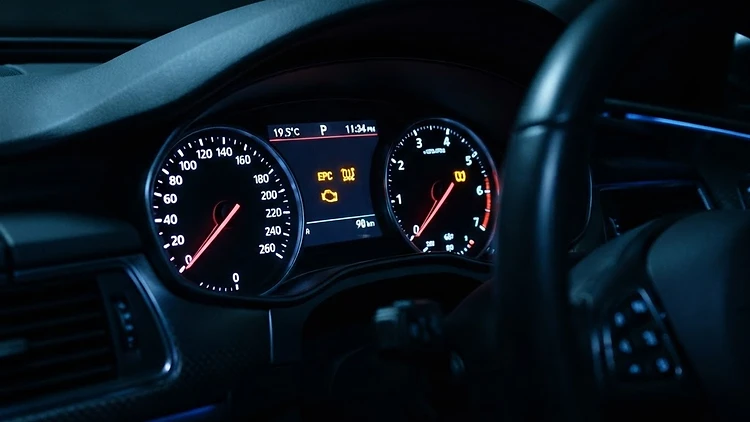
What EPC stands for
EPC is Electronic Power Control — VW Group's name for the drive-by-wire throttle system and its self-monitoring. The amber EPC lamp lights whenever the engine control unit detects a fault in the throttle, accelerator pedal or a related signal, and it very often appears with a loss of power, a raised idle or a throttle that responds oddly.
Unlike the engine management light, EPC is specific: it always points at the electronic throttle path or a signal the engine needs to control engine speed.
The usual causes
- Accelerator pedal position sensor — the most common cause on Golf/Passat/A3-era cars. There are two potentiometers inside the pedal; when their readings disagree, EPC lights and the engine defaults to a safe idle
- Throttle body carbon build-up — the motorised flap sticks or its position feedback becomes implausible, particularly on higher-mileage petrol engines
- Brake light switch — sounds unrelated, but a failed switch (or one with a stuck contact) breaks the throttle/brake plausibility check and lights EPC
- Wiring and connector faults — corrosion at the throttle body plug or chafed pedal loom
- Low system voltage — a weak battery causes spurious EPC faults at cranking
- Adaptation loss — after a battery replacement or flat battery, the throttle adaptations can be lost and need a basic setting
Is it safe to drive?
If the car will not rev beyond idle, it is in limp mode and should not be driven in traffic — the throttle may not respond as expected. If the light is on but the car drives normally, a gentle journey to a workshop is reasonable, but don't ignore it: an accelerator pedal that fails completely leaves you with idle-only power.
How we diagnose it
Live data is everything here. We read both accelerator pedal track voltages simultaneously while pressing the pedal, watch the throttle body position against commanded position, and check the brake light switch signal. That separates a pedal fault from a throttle body fault in minutes — and stops the common mistake of fitting a throttle body when the pedal is at fault, or vice versa.
Where adaptations are the cause, a manufacturer-level basic setting restores normal operation without any parts. Where the throttle body is genuinely carboned or worn, cleaning or replacement is straightforward.
EPC faults are diagnosed at our Telford workshop as part of advanced diagnostics, and on suitably equipped VW Group vehicles stored fault data can be read remotely through JVS Remote Connect.
Related reading
- VW Group coolant warning light — common causes
- VW Group specialist services
- Auto-electrical services
This article is general guidance for UK-market VW Group vehicles.