
BMW SOFTWARE & DIAGNOSTICS // 2026-10-27 // 4 min read
BMW Software Updates: What They Fix and Why They Matter
How BMW software updates resolve drivability, infotainment and module faults — and why the software level is checked as part of proper diagnosis before any part is replaced.
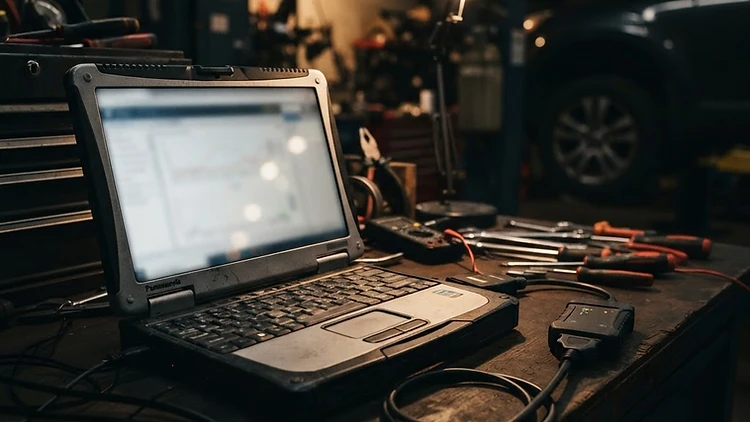
A modern BMW is less a car with a computer and more a computer network on wheels. Depending on model and specification, a BMW built over the last fifteen years carries anywhere between thirty and a hundred control units, each running its own software. Like any software, those programs have bugs, refinements and compatibility requirements, which is why BMW issues software updates throughout a vehicle's life, and why an out-of-date control unit can be the real reason behind a fault that first looks like a hardware failure.
What a BMW software update actually changes
A software update replaces the program stored inside one or more control units — the engine management system, transmission controller, infotainment computer, battery management, or dozens of other modules. Updates fall into a few broad categories:
- Fault corrections. BMW releases updated software when a known behaviour inside a control unit needs adjusting: an uneven idle, hesitant gear selection, an infotainment glitch or a warning message that appears for no obvious reason.
- Compatibility updates. After a module has been replaced, repaired or retrofitted, the surrounding control units sometimes need updating so the whole network communicates with the new hardware correctly.
- Function refinements. Some updates improve how existing features behave — heating strategies, charging behaviour on plug-in hybrids, or the way driver-assistance systems respond.
Faults a software update can genuinely resolve
Not every fault is software, but there are patterns we see repeatedly where the software level is a genuine suspect:
- Warning messages that appear intermittently and clear themselves, with no underlying hardware fault found during testing.
- Infotainment systems that are slow, reboot occasionally, or behave inconsistently with a particular phone.
- Driveability or shift-quality complaints that developed gradually rather than appearing after a mechanical event.
- A module replaced at another garage that has never quite worked properly since, because the surrounding units were never updated to accept it.
- Battery or charging system complaints after battery replacement, where the energy management software was never matched to the new battery.
Why software level is part of proper diagnosis
This is the part that gets missed. A fault code tells you where the system noticed a problem — it does not tell you what caused it. Before condemning any module, a proper diagnostic process checks the software level of the relevant control units against the manufacturer's current releases. Dealer-level diagnostic software such as BMW ISTA builds this into its test plans: many repair instructions explicitly begin with "update the software, then re-evaluate". Skipping that step risks replacing a component that was never faulty.
We describe our diagnostic approach in more detail in advanced vehicle diagnostics.
When an update alone won't fix the fault
Software is one suspect, not a cure-all. The same warning message can be caused by a failing sensor, a corroded connector, water in a module, or damaged wiring — none of which any update will touch. That is why we never sell a software update as a guaranteed repair. The fault is diagnosed first; the update happens because the evidence points there, not in the hope that it might help.
How updates are carried out safely
Programming a module is a controlled process with real risks if done badly:
- The vehicle needs a stable power supply — a proper support unit, not a cheap trickle charger. Voltage dropping mid-flash can leave a control unit unusable.
- The correct diagnostic session and procedure must be used for the exact module and vehicle, which is where manufacturer-level tools matter.
- Post-programming, the module may need coding, registration or adaptation steps so the vehicle recognises it and all functions restore correctly.
This work is carried out with dealer-level equipment as part of our BMW & MINI specialist services.
Remote software support
Some software, coding and programming work can also be carried out remotely on suitable vehicles. JVS Remote Connect allows us to work with BMW and MINI owners across the UK, subject to vehicle compatibility, the right equipment, a stable internet connection, suitable power support and a prior assessment.
Get it checked properly
Experiencing BMW electrical or software problems? Jono's Vehicle Solutions offers professional diagnostics, programming and repairs from our Telford workshop, covering Shrewsbury, Wem and the wider Shropshire area. Contact us with your symptoms and registration, and we'll establish what's actually going on — rather than replacing parts on a hunch.
Related reading: BMW iDrive boot loops · Why battery registration matters